
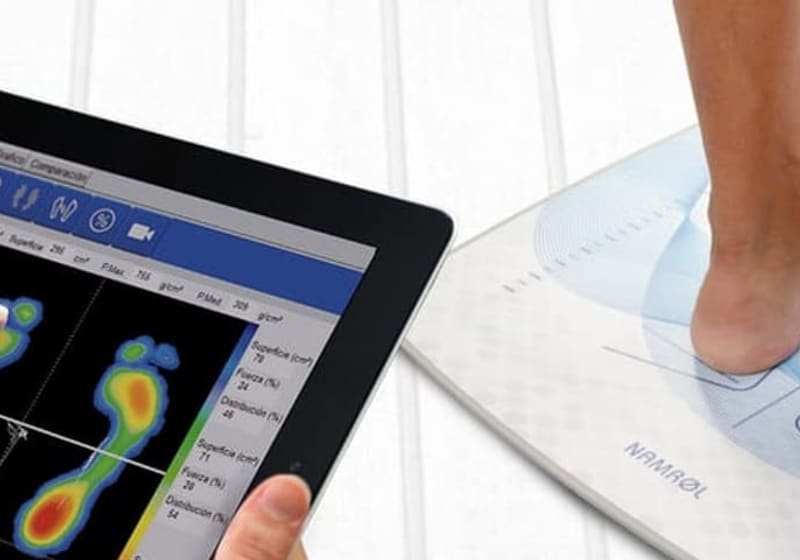
Recurring pain, a change in how you walk or a new training load are reasons to look at how the foot is loaded — not only at the sore spot.
A gait assessment is not a sporting extra or a shortcut to insoles. It is a clinical look at how you load the foot when standing, walking and, when relevant, running. In a podiatry clinic it helps explain pain, instability, uneven shoe wear or injuries that return as soon as you resume activity — even if they “settle with rest”.
At Podología Priego we request it when the history and examination suggest a loading problem, not as an automatic add-on to every visit. The same alignment does not mean the same thing in someone who walks to work, trains three times a week, or presents with hallux valgus, a tight soleus or repeated ankle sprains. Everyday shoes and sport shoes belong in the history; without them the study is incomplete.
What a biomechanical study looks at
The examination combines joint mobility, muscle strength, observation of the footprint and, when indicated, gait analysis. It is not only “pronation versus supination”. We look at rearfoot control, midfoot stability, how load moves into the forefoot, and how the knee and hip respond. A valgus rearfoot with a lax midfoot is not treated like a stiff forefoot that concentrates pressure under one metatarsal.
Context matters: surface, training volume, hours on your feet at work, body weight, previous injuries and surgery. A plantar fasciitis after a sudden mileage jump is not read the same way as fasciitis in a cavus foot, a short Achilles and a narrow last worn for years.
When there is pain, we correlate what we feel on the couch with what happens in stance and swing. Some overloads appear only at push-off or when braking. A proper study is a clinical hypothesis you can test with treatment and follow-up — not a generic “pronator insole” printout.
When to book
- Heel, arch or forefoot pain that returns when you resume walking or sport.
- Plantar fasciitis, metatarsalgia, Achilles tendinopathy, shin splints or neuroma that generic rest and a “more cushioned” shoe have not settled.
- Ankle instability, falls, or a foot that “turns over” without a clear sprain.
- Very asymmetrical sole wear, rubbing, black nails or ingrown nails with the same pair.
- A jump in volume, surface or discipline, or a new shoe started in peak season.
- Children or teenagers with pain, persistent toe-walking, frequent falls, or a shoe that wears out on one side only.
- A neuropathic or diabetic foot with callus that marks a pressure peak even when it does not hurt.
What happens in clinic
After the history we examine mobility, strength and tender points. If needed, we watch or record gait so we are not treating only what we feel off-load. We then decide whether footwear and exercise are enough, whether a local lesion needs treatment, or whether a custom foot orthosis adds off-loading or control that the shoe alone cannot give.
Insoles are not the goal of the study: they are a tool when the diagnosis justifies them. An honest assessment may conclude that the problem is the shoe, the training, a tightness that needs work, or a condition that another specialty should see first. Forcing an orthosis “just in case” is as unprofessional as refusing one when it is clearly indicated.
If an orthosis is prescribed, we choose materials and a shoe that can actually house it. A device that does not fit the daily shoe does not work. We explain the first weeks of adaptation and when to review: feet and training change; an orthosis is not a lifetime prescription without follow-up.
What it does not replace
Gait analysis does not replace X-ray, ultrasound or assessment by orthopaedics, rehabilitation or endocrinology when fracture, tendon rupture, systemic disease or high-energy injury is suspected. It does help us treat more than the symptom: many foot overloads are the result of a loading pattern that can be changed with footwear, exercise, off-loading and, sometimes, orthoses.
Bring the shoes you use most, your sport pair and any current insoles. If pain limits daily life or training, book at Podología Priego. A timely study is better than a three-month tendinopathy after a three-week overload.
Educational information. It does not replace an individual assessment or imaging your case may need.
General information: this does not replace an individual podiatry assessment.
Back to journal
Comments
No comments yet.
Leave a comment
Your comment will be reviewed before it appears.