
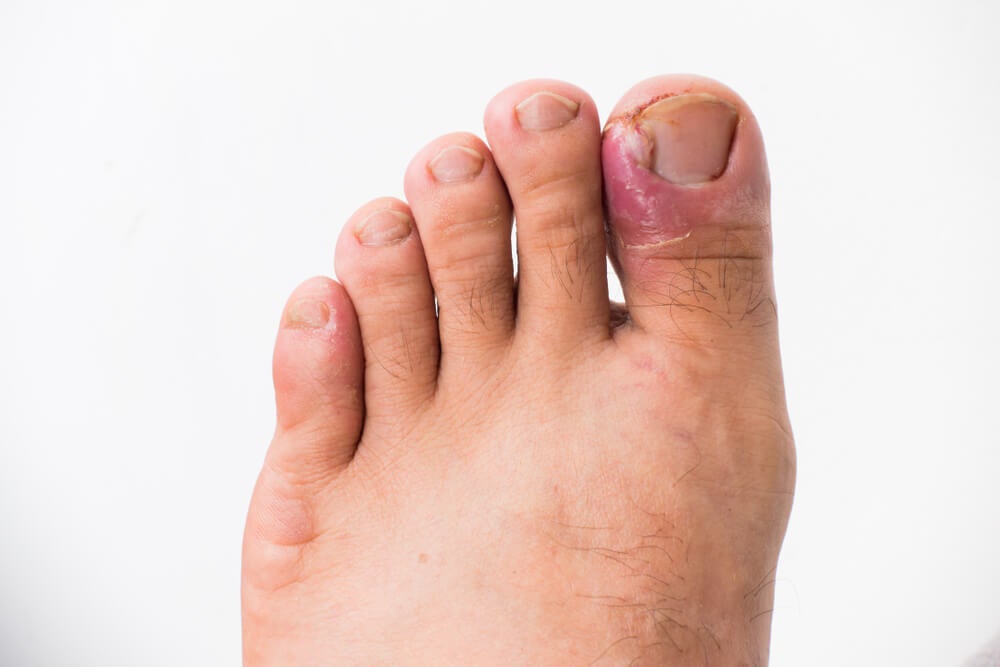
An ingrown nail can look small and still hurt with every step. Early conservative care matters more if you have diabetes or poor circulation.
What is that sharp feeling beside the nail? Most often it is an ingrown toenail (onychocryptosis): the edge or corner of the plate digs into the nail fold. It is common, especially on the big toe, and brings pain, swelling, redness and, if delayed, soft-tissue infection. Even when the lesion looks small, it hurts at every step: shoes and even bedsheets become the enemy.
At Podología Priego, cutting in clinic is not the same gesture as a pedicure. We see the spicule, assess the fold and the shoe and, if there is fungus or a thick nail, we treat the cause so the appointment is not repeated every month.
Why it happens
It is seen with thick (onychogryphotic) or dystrophic nails, but also with a narrow shoe, trauma (a ball, a kerb, a safety toe cap) or a rounded cut that leaves a spicule. The home “corner cut” is a classic: people try to relieve the edge and leave a fragment that digs in as it grows.
Fungal nail often deforms the plate and can be the origin of an ingrown nail. Treating only the edge without looking at fungus, footwear or a bunion that pushes the hallux favours recurrence. In active teenagers and in people who wear football boots or very pointed dress shoes, the pattern repeats in season.
On a neuropathic, diabetic, ischaemic or anticoagulated foot the same problem is no longer “minor”. An infection that starts at the nail can threaten the toe or the limb. That is not a “I’ll cut it on Sunday” job.
What we can do in clinic
In early stages treatment is conservative: the spicule is removed and a technique is chosen to re-educate the plate (orthonyxia or others, depending on the case). Knowing the cause is part of the plan. In advanced stages, with granuloma or infection, it may be necessary to act on the nail side or the fold, with the tests needed and informed consent, aiming for a solution that does not repeat every few weeks.
If there is pus, cellulitis or fever, the plan includes assessing infection and, when appropriate, coordinating with your doctor. We do not pack cotton and wait for miracles if the surrounding tissue is already compromised.
What not to do at home
- Do not use deep scissors or try to “take the nail out by the root”.
- Do not put corn plasters on an inflamed fold.
- Do not squeeze the toe into a narrower shoe “so it does not move”.
- If there is pus, fever or you are an at-risk patient, do not wait until Monday.
Book via contact. The earlier it is treated, the less likely a nuisance becomes cellulitis. And if the nail always ingrows on the same side, let us talk about shoes and cutting technique, not only “the spicule again”.
Ingrown-nail treatment is decided according to stage and each person’s vascular or neuropathic risk.
General information: this does not replace an individual podiatry assessment.
Back to journal
Comments
No comments yet.
Leave a comment
Your comment will be reviewed before it appears.